


The Lift-the-Pot Method: One of the Simplest Skills a Grower Can Learn
By east Coast Collaboration
One of the most useful tools in a home grow does not plug into the wall.
It does not need batteries.
It does not connect to an app.
And it does not cost anything.
It is simply learning how your container feels when it is wet compared with when it is dry.
Growers often call this the lift-the-pot method.
It sounds almost too simple, but learning container weight can take a lot of the guesswork out of watering.
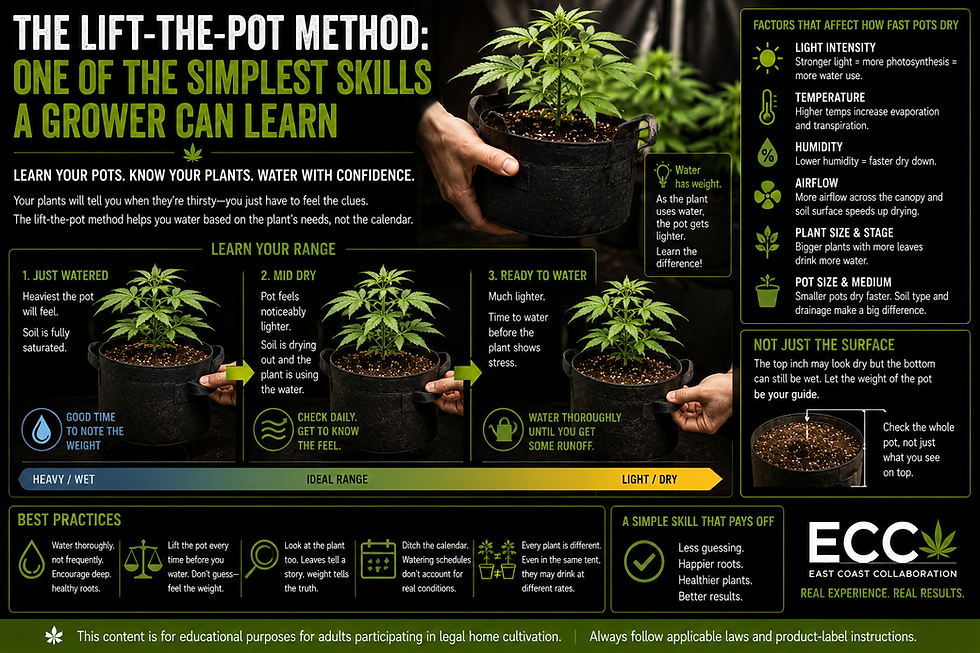
Why Container Weight Tells You So Much
Water is heavy.
When you completely water a container, the growing medium absorbs moisture and the pot becomes noticeably heavier.
As the plant uses that water and moisture evaporates from the soil, the container becomes lighter.
That changing weight gives you a direct clue about how much moisture remains inside the root zone.
Instead of watering because a certain number of days have passed, you can respond to what is actually happening inside the pot.
Learn the Wet Weight First
The easiest time to begin learning the method is immediately after a proper watering.
Pick up the container.
You do not need to know the exact weight.
Just notice how it feels.
That becomes your reference point for a well-watered pot.
Then lift it again the next day.
And the next.
As moisture disappears, the difference becomes increasingly obvious.
After doing this repeatedly, many growers can tell whether a plant needs water within seconds.
Learn What a Dry Pot Feels Like
The other important reference point is a container that has dried down significantly.
You do not need to allow the plant to become severely wilted every time.
The goal is simply to recognize how dramatically lighter the container becomes as moisture is used.
Once you understand both ends of the range, everything in between becomes easier to judge.
That experience is much more useful than memorizing a schedule.
Why Watering Schedules Can Be Misleading
A schedule might say:
Water every three days.
But what if the plant uses the water in two days?
What if it takes five?
What if the room becomes hotter?
What if humidity increases?
What if the plant suddenly grows twice as much foliage?
All of those things can change water use.
A fixed calendar cannot adjust automatically.
Container weight can.
Plants Drink More as They Grow
A young plant with a small root system may use water slowly.
A larger plant with a developed canopy may use significantly more.
That means the same pot that once stayed wet for four days might later dry out in two.
This is normal.
The plant changed.
Its watering needs changed with it.
Learning pot weight makes those changes easy to recognize.
Environment Changes Water Use Too
Temperature, humidity, airflow, and light intensity all influence how quickly water moves through a plant.
Warmer conditions can increase water use.
Lower humidity may increase transpiration.
Stronger light can also increase demand.
If the environment changes, the container may begin drying at a different rate.
That is why watering and environmental monitoring are connected.
The plant is responding to the entire grow space.
Pot Size Makes a Difference
Small containers hold less growing medium and less water.
They may dry quickly.
Large containers hold more moisture and can stay wet much longer.
A small plant in a large pot may also take a long time to use the available water because its root system has not filled the container yet.
This is another reason there is no universal watering schedule.
The same plant can behave very differently depending on the container.
Growing Medium Matters
Different soils retain different amounts of moisture.
A dense mix may stay wet for a long time.
A lighter, highly aerated mix may dry faster.
Perlite, peat moss, coco, compost, and other ingredients all influence water retention and drainage.
The lift-the-pot method works because it adapts to the actual growing medium being used.
You do not need to guess how much water the mix is holding.
The weight gives you a clue.
Don't Judge Only by the Soil Surface
The top inch of soil can look dry while plenty of moisture remains deeper in the container.
That can cause growers to water too soon.
On the other hand, a surface that still looks slightly moist does not always mean the entire root zone has plenty of water.
Looking at the surface is useful.
But it should not be the only thing you use.
Container weight gives you information about the whole pot.
Fabric Pots Make This Especially Easy
Fabric containers are popular among home growers because they provide strong aeration and drainage.
They are also easy to lift.
Even larger fabric pots can often be tilted slightly to judge their weight without completely picking them up.
The difference between a freshly watered fabric pot and a dry one can be very noticeable.
That makes them particularly useful for developing this skill.
Water Thoroughly When You Do Water
Learning when to water is only half the equation.
When the plant genuinely needs water, the root zone should receive enough moisture to rehydrate evenly.
Small amounts of water applied constantly can encourage uneven moisture distribution.
Some areas may remain wet while others stay dry.
A thorough watering followed by an appropriate dry-down period helps create a more predictable cycle.
Don't Wait for Severe Wilting Every Time
Some growers wait until the plant visibly collapses before watering because they want to be certain the pot is dry.
That is not necessary.
Severe wilting is stress.
The goal of the lift-the-pot method is to recognize the plant's needs before it reaches that point.
With experience, you begin identifying the correct range based on weight long before the plant becomes dramatically thirsty.
Compare Similar Containers
If you have several plants in the same size pots, comparing them can be extremely helpful.
Pick up one container.
Then another.
You may immediately notice that one is much lighter.
That plant may simply be using water faster.
This is a great example of why plants should sometimes be treated individually even when they share the same grow space.
One Plant May Drink Faster Than Another
Even identical container sizes and growing media do not guarantee identical water use.
Plant size matters.
Root development matters.
Genetics matter.
Position under the light can matter.
One plant may consistently dry faster than its neighbor.
That does not necessarily mean anything is wrong.
It may simply have different needs.
The lift-the-pot method allows you to recognize that difference instead of watering every plant automatically.
Moisture Meters Can Help, But They Are Not Everything
There are plenty of moisture meters available.
Some can be useful.
Sensors and environmental monitoring can also provide valuable information.
But technology works best when the grower understands the fundamentals behind the numbers.
If you know what a wet pot and a dry pot feel like, you have a simple reference that does not depend on a device.
Technology can then support your observation instead of replacing it.
Experience Builds Quickly
At first, you may feel like you cannot tell much difference between containers.
Keep practicing.
Lift the pot after watering.
Lift it again later.
Pay attention to how the plant looks at different weights.
After enough repetition, the difference becomes obvious.
Eventually, you may not even need to fully lift the container.
A slight tilt can tell you what you need to know.
That is experience developing in real time.
The Bigger Lesson
Good watering is not about following a calendar.
It is about understanding how much moisture remains available to the root system.
The lift-the-pot method teaches you to combine:
Container weight.
Plant appearance.
Growing medium.
Plant size.
Environmental conditions.
Together, those clues create a much more accurate picture than a fixed watering schedule ever could.
Sometimes the simplest techniques are the ones that remain useful throughout an entire lifetime of growing.
At East Coast Collaboration, the goal is to teach growers skills they can actually use—not just numbers they have to memorize.
Real Experience. Real Results.
East Coast Collaboration provides educational information for adults participating in legal home cultivation. Always follow applicable laws and product-label instructions.


Comments