


Reading Cannabis Leaves: What Color, Shape, and Position Can Tell You
By East Coast Collaboration
One of the best diagnostic tools in a grow room is already attached to the plant.
The leaves.
Cannabis leaves constantly respond to what is happening around them.
Water.
Light.
Temperature.
Humidity.
Nutrition.
Root health.
Airflow.
A single unusual leaf does not always mean there is a problem, but patterns across the plant can provide valuable clues.
Learning how to read those patterns is one of the most useful skills a home grower can develop.
Start With the Whole Plant
One of the easiest mistakes to make is finding one damaged leaf and immediately diagnosing the entire plant.
Leaves get damaged.
Older leaves age.
A branch may get bumped.
A water droplet may leave a mark.
One leaf does not always represent what is happening throughout the plant.
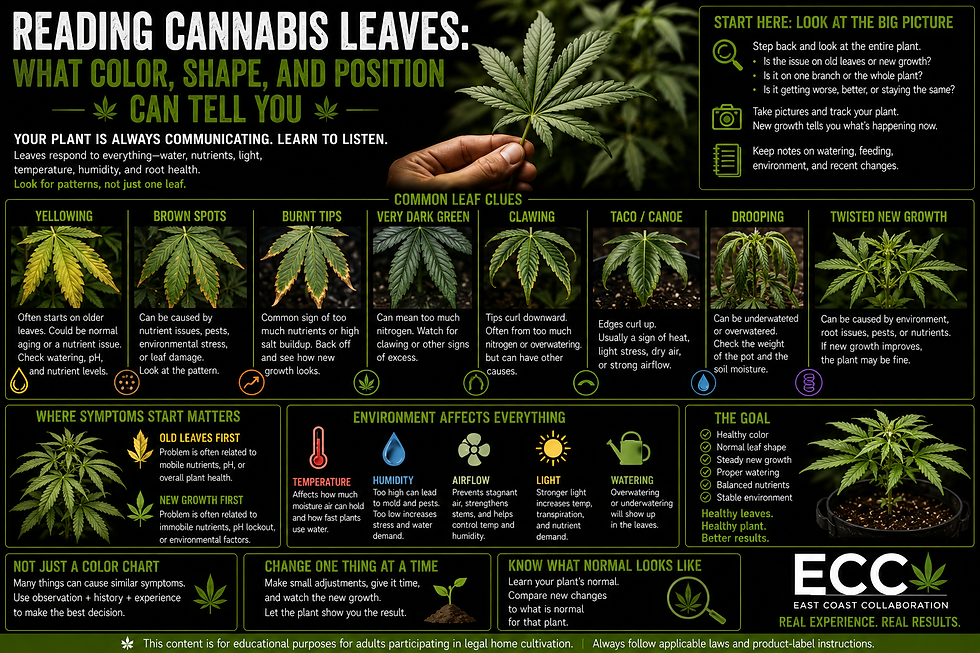
Before making any changes, step back and look at the entire plant.
Ask:
Is the problem happening everywhere?
Is it only on one branch?
Is it affecting old growth or new growth?
Is it spreading?
Is the plant still growing normally?
Patterns are much more useful than isolated symptoms.
Leaf Color Can Tell a Story
Healthy cannabis leaves are generally green, but there is no single perfect shade.
Genetics can produce naturally lighter or darker foliage.
Growth stage can also influence color.
That means the goal should not be to make every plant the darkest green possible.
Instead, watch for significant changes from what is normal for that particular plant.
Yellowing Leaves
Yellow leaves are one of the most common things growers notice.
But yellowing does not automatically mean one specific deficiency.
Possible causes can include:
Nutrient issues
Root-zone problems
Improper watering
pH-related nutrient availability
Environmental stress
Natural aging
Where the yellowing begins can provide additional information.
If older leaves begin changing first, that may point in a different direction than yellowing that begins in the newest growth.
That is why location matters.
Older Leaves vs. New Growth
Plants can move some nutrients from older tissue to newer growth.
Other nutrients are less mobile inside the plant.
Because of this, certain problems tend to appear first on older leaves while others show up in newer growth.
You do not need to memorize every deficiency chart immediately.
Just begin by asking:
Where did the symptoms start?
That one question can narrow things down considerably.
Brown or Rust-Colored Spots
Brown spots can make growers nervous because they often appear suddenly.
But once again, there can be several possible causes.
They may be connected to nutrition, root-zone conditions, physical damage, environmental stress, or other factors.
Look at the pattern.
Are the spots appearing on several plants?
Only older leaves?
Only near the top?
Did they appear after a recent change?
The context matters just as much as the spot itself.
Burnt Leaf Tips
Brown tips at the very ends of leaves are commonly associated with excessive nutrient strength.
Growers often refer to this as nutrient burn.
A small amount of tip burn does not necessarily mean the plant is in serious trouble.
But it can be useful feedback.
If the tips begin burning shortly after increasing nutrient strength, the plant may be telling you that the feeding level is approaching or exceeding what it comfortably needs.
This is a good example of why gradual changes are easier to manage.
Very Dark Green Leaves
Dark green foliage can look impressive.
But extremely dark leaves can sometimes be a sign that the plant is receiving more nitrogen than it needs.
Other symptoms may appear alongside it, including downward curling or clawing.
Again, compare the plant with its normal appearance.
A cultivar that naturally grows dark green should not be diagnosed simply because another plant beside it is lighter.
What Is Leaf Clawing?
Clawing describes leaves whose tips curve sharply downward.
The shape can resemble a claw.
Several stresses can influence leaf position, but excessive nitrogen is one common reason growers associate with this appearance.
Overwatering and other root-zone stresses can also affect leaf posture.
That is why the leaf shape alone should not be the entire diagnosis.
Look at the watering history, feeding history, and overall plant.
Leaves Pointing Upward
Growers sometimes describe healthy leaves pointing upward as “praying.”
A slight upward posture can occur when a plant is actively growing and responding well to its environment.
But extreme upward curling or taco-shaped leaves can mean something different.
Context matters.
A healthy upward posture is not the same as edges curling aggressively toward the light.
Taco or Canoe-Shaped Leaves
When leaf edges curl upward, the leaf can begin looking like a taco or canoe.
This may be associated with environmental stress such as:
Excessive light intensity
High leaf temperature
Very dry conditions
Strong airflow
If the upper canopy is affected much more than the lower plant, light or heat becomes particularly worth investigating.
Drooping Leaves
Drooping is another symptom with more than one possible cause.
An underwatered plant may droop.
An overwatered plant may also droop.
That is why leaf position should be combined with container weight and soil moisture.
If the leaves are drooping and the pot feels extremely light, the plant may be thirsty.
If the leaves are drooping while the container is still heavy and saturated, watering again could make the situation worse.
The leaves give you a clue.
The pot helps complete the picture.
Twisted or Deformed New Growth
New leaves occasionally emerge twisted or irregular.
This can happen for several reasons.
Sometimes young plants simply grow through minor deformities.
Other times persistent abnormal growth may suggest environmental, root-zone, pest, or nutritional issues.
The key word is persistent.
If one strange leaf appears and the next several sets look normal, there may be very little reason for concern.
Always watch what the newest growth does next.
Leaf Position Changes During the Day
Leaves do not always remain in exactly the same position throughout the entire light cycle.
They may rise after the lights come on.
They may relax later.
Some plants noticeably lower their leaves as the dark period approaches.
That means a photograph taken at one moment does not always tell the complete story.
Learning your plant's normal daily rhythm makes unusual behavior easier to recognize.
New Growth Is Important
Damaged leaves usually do not repair themselves.
A brown spot will not turn green again.
A burnt tip will not rebuild itself.
That means staring at the same damaged leaf every day can be misleading.
Instead, look at what happens after you make an adjustment.
Is the new growth healthy?
Has the problem stopped spreading?
Is the plant continuing to develop?
Improvement often appears in what the plant produces next.
Compare Plants Carefully
If several plants share the same environment and all begin showing the same symptom at roughly the same time, that may point toward a common factor.
Environment.
Water.
Feeding.
Lighting.
If only one plant is affected, genetics or an individual root-zone issue may be more likely.
Comparison can be incredibly useful.
Just remember that individual plants can still have different needs.
Take Pictures
One of the easiest ways to improve your diagnostic ability is to photograph your plants regularly.
Not just when something is wrong.
Pictures create a visual history.
You can compare:
Leaf color
Canopy development
New growth
Stretch
Plant posture
Symptom progression
A change that feels dramatic today may look much smaller when compared with a photograph from three days ago.
Documentation removes some of the guesswork.
Don't Diagnose From a Chart Alone
Deficiency charts can be useful.
But they can also encourage growers to match a leaf to a picture and immediately add a nutrient.
Plants are more complicated than that.
Several different problems can produce similar-looking symptoms.
A better diagnosis combines:
Leaf appearance.
Location of symptoms.
Watering history.
Feeding history.
Environment.
Root-zone conditions.
Recent changes.
That larger picture gives you a much better chance of identifying what is actually happening.
Avoid Changing Everything at Once
If you believe you have identified a problem, make thoughtful adjustments.
Changing the light, nutrients, watering schedule, temperature, humidity, and airflow simultaneously makes it almost impossible to learn from the plant's response.
Change what has a clear reason to be changed.
Then watch the new growth.
Good growers are constantly gathering information.
Learn What Healthy Looks Like First
The easiest way to spot a problem is to know what normal looks like.
Pay attention to your plants when they are healthy.
Learn their normal color.
Their normal leaf posture.
How quickly they grow.
How they look before and after watering.
How they respond to the light cycle.
Once you know the baseline, changes become much easier to recognize.
The Bigger Lesson
Leaves are information.
They are not perfect diagnostic computers, but they are constantly responding to the environment around them.
The goal is not to memorize hundreds of leaf symptoms.
It is to learn how to observe.
Look for patterns.
Compare old and new growth.
Consider where symptoms begin.
Connect what you see with watering, feeding, lighting, and environmental history.
And remember that one damaged leaf does not always mean you have a damaged plant.
At East Coast Collaboration, the goal is to help growers learn how to read their plants instead of reacting to every change with another product.
Real Experience. Real Results.
East Coast Collaboration provides educational information for adults participating in legal home cultivation. Always follow applicable laws and product-label instructions.


Comments